Web / PWA
- Receives new features first.
- The version used by the author as the main release.
- Runs without prior installation.
- Installable as a PWA on Windows and other supported desktop platforms.
Orcalot is a self-contained audiovisual livecoding studio for procedural music, Bytebeat, synthesis, samples, MIDI and reactive shaders.
Built around the concise ORCA language and designed as one integrated creative environment.
Always up to date. Installable as a PWA.
Compact App Store release. About 10 MB.
Free · No account · Web-first · Installable · Works across desktop platforms
Open the freshest version in your browser or use the compact macOS release. Both are Orcalot; the web app is the primary and most up-to-date channel.
The web app receives new features first. Mac App Store releases follow after Apple’s review process.
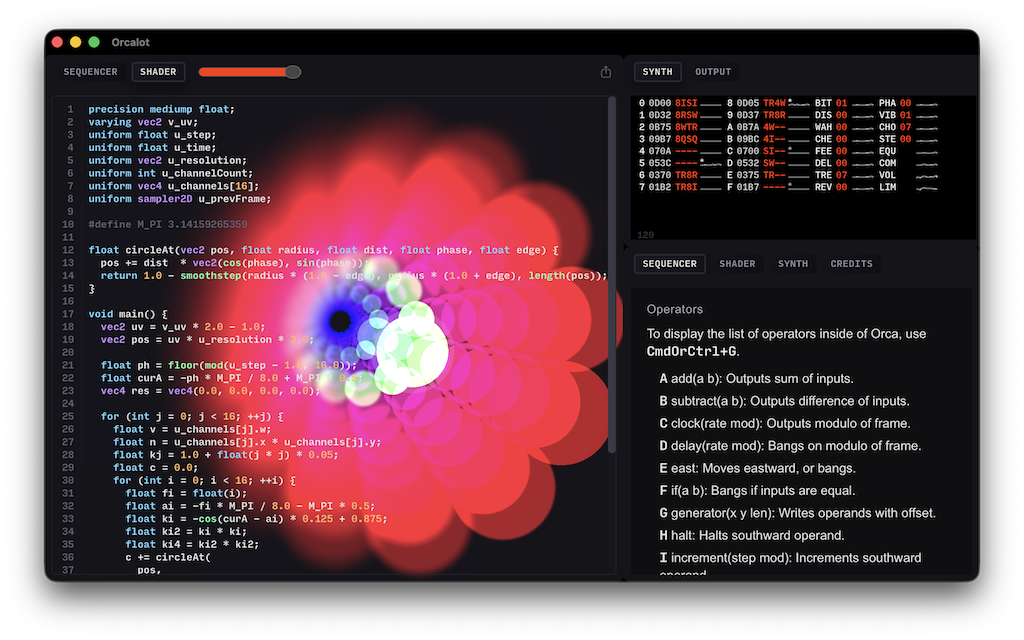
Audiovisual work often means moving between a livecoding environment, synthesizer, MIDI or event routing, shader editor, media tools and separately saved state. Orcalot brings those parts into one project and one interface, so you can open your work and start creating.
Program generative music with the concise ORCA language. Edit while it runs, work with an optimized runtime, reuse prefab patterns and transpose grid notes as ideas evolve.
Combine AM, FM, Mono, Pluck, Membrane, Noise, Sampler, SoundFont and Bytebeat engines. Write safe integer expressions, inspect them in a zoomable and pannable waveform preview, and restart time per note or keep it running for long compositions.
Edit shaders driven by musical data. Bring images and looping video into the visual system and build time-aware effects for creative coding and live visual performance.
Keep the grid, graphics, theme, channel settings, Bytebeat code, SoundFont and samples together in a portable .orcalot project. Record ideas, reopen older projects and import legacy .orca grids.
Orcalot began as a tool I built for myself. I wanted a concise way to create procedural music and found the ORCA language especially appealing. But working with sound required a separate synthesizer, additional setup and separate documentation.
The first version brought ORCA, Pilot and their documentation into one application. From there, Orcalot gradually became its own integrated environment. It moved from Electron to Tauri, gained a shader editor driven by musical data, and received a redesigned interface, an optimized and refactored ORCA runtime and a substantially rewritten audio engine. Of Pilot, mainly the original external idea remains.
Samples, SoundFonts, Bytebeat, richer channel controls, prefab libraries, images and video were added as they became useful in my own work.
Orcalot is still developed according to the same principle: I add what I personally need and shape the workflow around how I would want an audiovisual tool to work.
Orcalot uses the ORCA livecoding language originally created by Hundred Rabbits. Its early audio integration was inspired by Pilot. Orcalot’s current application, runtime, interface, audio workflow and visual system are independently developed.
Questions, ideas and work made with Orcalot are welcome in the Orcalot community on Discord.